
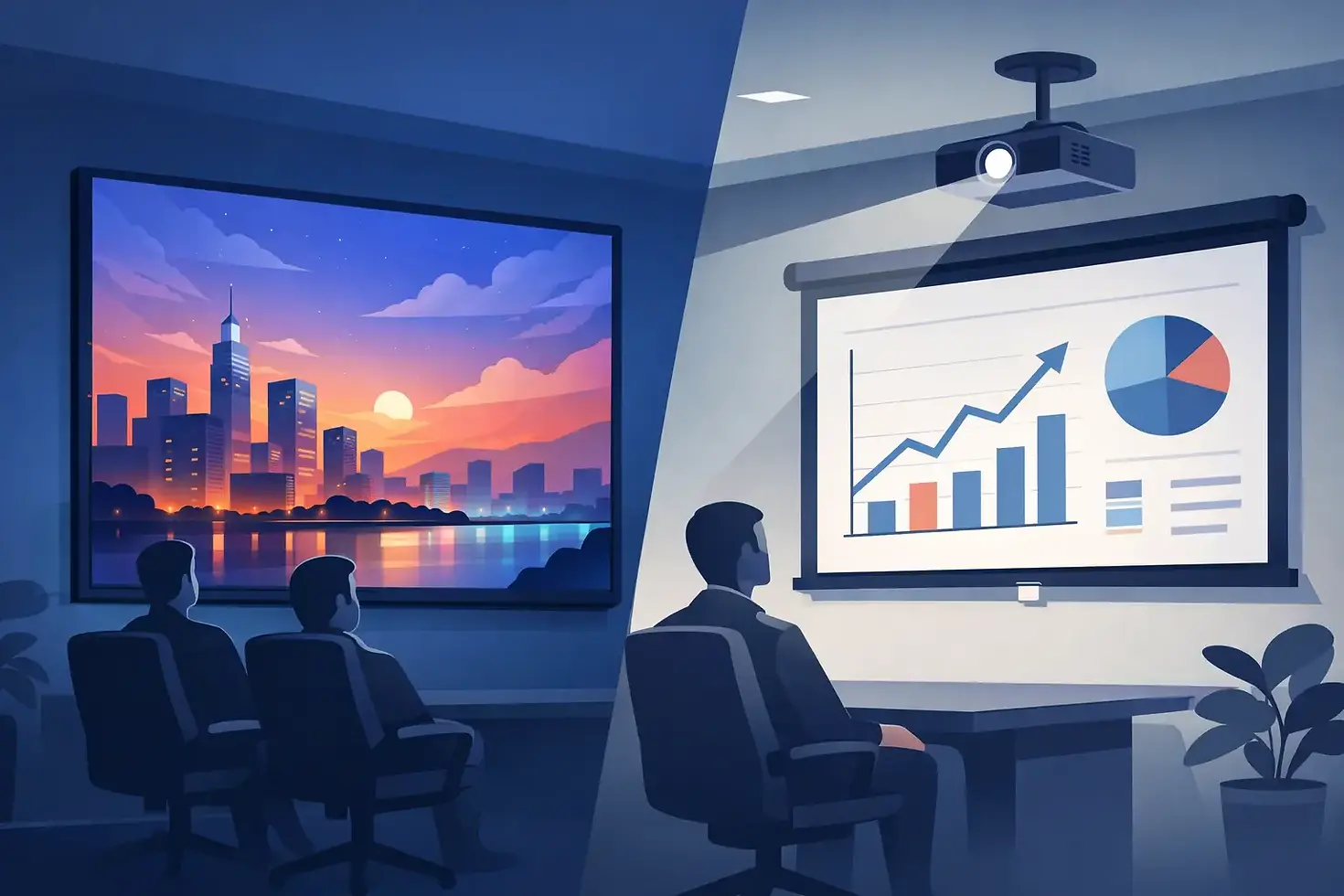
Indoor LED Versus Projection Screens Compared

A washed-out presentation in a brightly lit sanctuary, a keynote disrupted by shadows, or an event screen that disappears on camera can undermine an otherwise polished experience. When comparing indoor LED versus projection screens, the real question is not which technology is newer. It is which display will keep your message visible, vivid, and dependable in the way people actually use your space.
For churches, schools, corporate lobbies, event venues, and retail environments, both options can have a place. But they solve different visual problems. A projector can be a practical choice for occasional, controlled-use presentations. An indoor LED video wall is built to make content a permanent, high-impact part of the environment.
Indoor LED Versus Projection Screens: The Core Difference
Projection works by throwing light onto a screen. Its results depend on the projector’s output, the quality of the screen, the distance between them, ambient light, and proper alignment. If any part of that setup changes, image quality can change with it.
Indoor LED displays create their own light. Thousands of individual LEDs form the image directly on the display surface, producing strong color, contrast, and brightness without relying on a darkened room. That difference matters when your audience is walking through a lobby, seated beneath house lights, filming on phones, or viewing content from multiple angles.
A projection screen can be effective when the room is intentionally designed around projection. An LED wall is often the stronger long-term choice when the display needs to perform as a focal point, not simply a presentation tool.
Brightness Changes the Entire Viewing Experience
Ambient light is one of the biggest dividing lines between these technologies. Even quality projectors compete with windows, overhead fixtures, stage lighting, and daylight spilling through open doors. Raising projector brightness can help, but it also increases equipment cost, heat, fan noise, and maintenance demands.
An indoor LED display maintains a bright, saturated image in conditions that make projection look faded. That gives facilities more freedom to keep lights on, use natural light, and create an inviting room without sacrificing the screen. For a worship space, it means lyrics and sermon visuals stay readable. For a company briefing room, charts and video remain clear. For an event venue, sponsors and branded content continue to stand out throughout the program.
Brightness is not about making every image blindingly intense. It is about having enough output and control to tune the wall to the room. A professionally specified LED display can be calibrated for comfortable indoor viewing while retaining the visual authority needed for high-traffic spaces.
Image Quality Is More Than Resolution
Buyers often start with resolution, and it matters. But an effective indoor display also depends on color consistency, contrast, refresh rate, viewing angle, and pixel pitch. Pixel pitch is the distance between LEDs. A tighter pixel pitch creates a sharper image at closer viewing distances, which is especially valuable in boardrooms, houses of worship, retail interiors, and event spaces where guests may stand only a few feet away.
Projectors can deliver excellent detail in the right conditions, especially in dedicated theaters and dark presentation rooms. Yet they can lose perceived contrast quickly once ambient light enters the room. Blacks become gray, colors lose their depth, and fine text becomes harder to read.
LED video walls offer rich color and strong contrast because the screen itself produces the image. They also provide wide viewing angles, so attendees sitting off-center are less likely to see a dull or distorted picture. For audiences that move around a space rather than sit in fixed rows, that consistency is a major advantage.
Consider the Room, Not Just the Screen Size
A large projected image can look like the most economical path on paper. But the installation may require more planning than expected. Projector throw distance, mounting location, ceiling height, lens selection, cable routing, shadows, and screen placement all affect the final result. People walking between the projector and screen can block the image. Presenters can cast shadows on the content. A ceiling-mounted projector may also become an obvious object in an otherwise refined space.
LED walls are modular, allowing a display to be configured around the wall and the audience. They can be built in common 16:9 formats, wide panoramic layouts, custom dimensions, or integrated architectural designs. The front-facing screen can become a clean, commanding visual centerpiece instead of a device that must be protected from obstructions.
That does not mean LED is automatically right for every room. If a space is small, used only a few times each month, and can be darkened easily, a projector may provide the functionality needed at a lower initial cost. The stronger case for LED appears when visibility, frequent use, flexible lighting, and long-term presentation quality are priorities.
Upfront Cost and Long-Term Value Tell Different Stories
Projection often wins the first-price comparison. A basic projector and screen can be less expensive to purchase than a professional LED video wall. For temporary presentations, small meeting rooms, or occasional movie nights, that can be the sensible decision.
The long-term picture deserves equal attention. Projectors have lamps or light sources with finite life, filters and cooling systems that require attention, and optics that can collect dust or drift out of alignment. A dimming projector may need service or replacement just when a major event is approaching. Screen surfaces can also wrinkle, stain, or become damaged.
LED displays are a larger capital investment, but they are designed for extended operation and repeat use. Their modular construction also allows service to focus on individual components rather than replacing an entire display. For organizations using visual content every day, the value comes from reduced compromise: no dark-room requirement, fewer visibility issues, and a display that can support everything from announcements to live video and advertising.
Financing can change the decision as well. Rather than delaying a high-impact installation for years, many organizations can spread the investment into a more manageable payment structure while benefiting from the display immediately.
Content Flexibility Favors LED for Active Environments
Both technologies can show presentations, video, live camera feeds, and digital signage. The difference is how confidently they can support those uses day after day.
An LED wall can become the visual engine of a space. In a church, it can shift from countdown graphics to worship lyrics, sermon points, live IMAG, and community announcements. In a school, it can welcome visitors, support assemblies, and energize athletic events. In a corporate environment, it can display dashboards, branded messaging, training content, and event visuals without asking staff to rearrange the room around a projector.
This level of flexibility works best when the display comes with practical support. The Pixel Man helps customers move beyond the hardware with custom planning, professional installation, software training, warranty coverage, and display solutions matched to the viewing distance and application. The goal is not to sell the biggest wall possible. It is to build a display that looks right, works reliably, and gives your team confidence using it.
When Projection Is Still the Better Fit
Projection remains a smart option for certain applications. A dedicated dark theater, a low-use training room, or a temporary setup with a limited budget may not need the output and permanence of LED. Projection can also be easier to transport for a simple one-time presentation where lighting is fully controlled.
Be realistic about the trade-off. If the screen is expected to compete with daylight, overhead lighting, stage production, cameras, or a busy public environment, projection can become a compromise that everyone notices. If the display is central to the experience, an LED video wall turns that compromise into an opportunity for stronger engagement.
Make the Display Match the Mission
The best display decision starts with a few practical details: how close people will stand, how much ambient light the room receives, what content will run, how often the screen will be used, and whether the display needs to impress at first glance. Those answers point to the right pixel pitch, size, brightness level, and installation approach.
A projector can fill a wall. The right indoor LED wall can transform the room around it. When your message needs to be seen clearly and remembered long after the event ends, choose the technology that gives it the presence it deserves.


Comments